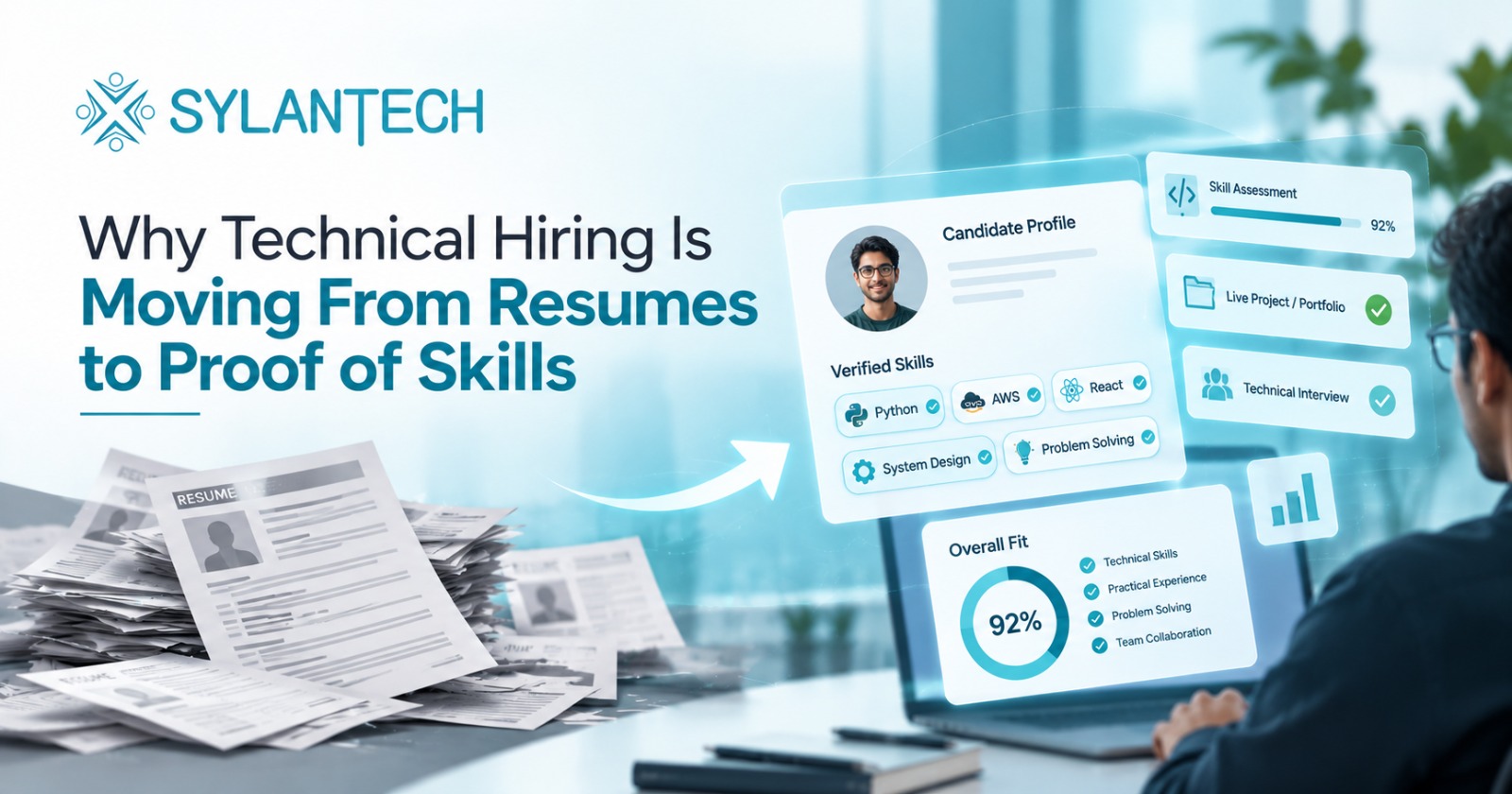
For years, the resume was the starting point of every technical hire. A list of past employers, degrees, and tools was treated as evidence of ability. Today, more companies are asking a different question: can this person actually do the work, and can they show it?
That shift, from resumes to proof of skills, is changing how technical teams find, assess and hire talent.
Why Resumes Are Losing Their Weight
Resumes still have a place, but they have clear limits for technical roles.
They describe; they don't demonstrate. "Proficient in Python" can mean anything from a weekend tutorial to years of production work.
They are easy to polish. AI writing tools now make almost every resume look strong and keyword-perfect.
They favour pedigree over ability. Big-name employers and universities can hide weak skills, while strong self-taught candidates get filtered out.
They are slow to read. Recruiters scan hundreds of near-identical profiles and still don't know who can perform.
The result is a mismatch: the document used to screen candidates tells you the least about how they will work.
What Proof of Skills Looks Like
Proof of skills means evidence that a candidate can do the job, gathered from real work or realistic tasks. It usually includes five sources.
1. GitHub and Code Portfolios
Public repositories show how a candidate writes, structures, and documents code. Recruiters can see commit history, code quality, and collaboration through pull requests and open-source contributions.
What to look for: Clear code, useful documentation, steady activity, and thoughtful responses to feedback, not just star counts.
2. Technical Assessments
Coding tests, system design exercises, and take-home tasks let you see problem-solving in action. Well-designed assessments mirror the real job instead of testing trivia.
What to look for: Practical, time-fair tasks followed by a conversation about the candidate's reasoning and trade-offs.
3. Real Projects
Personal projects, freelance work, hackathon entries, and case studies show initiative and the ability to finish something. A working project says more than a bullet point on a resume.
What to look for: Projects the candidate can explain end to end, including what went wrong and what they changed.
4. Certifications
Cloud, security, data, and platform certifications confirm a baseline of knowledge and a commitment to learning. They work best as supporting evidence alongside hands-on proof.
What to look for: Current, relevant certifications, and the candidate's ability to apply what they cover.
5. Demonstrated Capability
This is the broadest category: technical blogs, talks, mentoring, code reviews, live problem-solving, and trial projects. It shows how a candidate thinks and communicates, not only what they know.
What to look for: Clear explanations, sound judgment, and the ability to work with others.
Why This Shift Is Happening Now
Several forces are pushing hiring in this direction.
AI-polished resumes. When every resume looks perfect, resumes stop separating strong candidates from average ones.
Faster-changing skills. Tools and frameworks change quickly, so a job title from three years ago says little about current ability.
Skills shortages. Companies can't afford to ignore capable people who lack a traditional background.
Costly bad hires. A wrong technical hire wastes salary, team time, and project momentum. Proof reduces that risk.
Remote and global hiring. When you can't meet in person or judge by familiar names, visible work becomes the common language.
Benefits for Employers and Candidates
For employers: better quality of hire, fewer mis-hires, a fairer and wider talent pool, and faster decisions based on evidence.
For candidates: a chance to be judged on ability rather than background, and a clear way to stand out through real work.
Pitfalls to Avoid
Proof-of-skills hiring only works when it is done well.
Don't make assessments too long. Unpaid, multi-day tasks push strong candidates away. Keep them focused and respectful of time.
Don't treat GitHub as the only proof. Many excellent engineers work on private code and have little public activity.
Don't test trivia. Match tasks to the real work of the role.
Guard against bias and cheating. Use consistent scoring, clear rubrics, and a follow-up conversation to confirm the candidate understands their own work.
Don't throw out experience. Resumes still give useful context. Proof should add to the picture, not replace it entirely.
How to Build a Proof-of-Skills Hiring Process
Define the skills the role needs. List the real tasks, not just the tools.
Accept multiple forms of proof. Allow portfolios, projects, assessments, or certifications.
Design realistic assessments. Keep them short, relevant, and clearly scored.
Add a technical conversation. Ask candidates to walk through their work and explain their decisions.
Give feedback. A good candidate experience protects your employer brand.
Review and improve. Track which signals actually predict success on the job.
The resume isn't disappearing, but it is no longer the deciding factor. Technical hiring is moving toward evidence: code that can be read, tasks that can be observed, and capability that can be shown. Companies that make this shift hire with more confidence, and candidates get a fairer chance to prove what they can do.
Want a hiring process built on proof, not promises? Partner with an end-to-end recruitment team that screens, assesses, and places talent based on demonstrated skills.